

Stylish Umbrellas for Everyday Use: What to Look For
Quick Summary
The best stylish umbrellas for everyday use balance a sturdy, wind-resistant frame, a canopy wide enough to cover your shoulders, and a design that suits your outfit. Match the umbrella's size and style to your commute, your wardrobe and the weather you face most often.
- Choose a frame with fiberglass or fiberglass-reinforced ribs, which flex under wind and return to shape.
- Ten or more ribs distribute wind load more evenly and hold the canopy taut than standard eight-rib designs.
- A vented canopy lets gust pressure escape upward and reduces inversion in strong wind.
- Test how a patterned umbrella looks rolled up before buying, especially if you carry it in a tote.
- Pair one statement umbrella with a neutral outfit, or choose a tone-on-tone design when your outfit is already patterned.
Table of Contents
- What Makes an Umbrella Worth Carrying Every Day
- Best Umbrella for Wind and Rain: How Frame and Canopy Hold Up
- Stylish Compact Umbrellas for Bags, Totes and Commutes
- Best Stick Umbrella for Full Coverage and Everyday Wear
- Best Large Umbrella for Shared Coverage and Wide Canopies
- Matching Umbrella Style to Your Outfit and Daily Routine
- Choosing Your Everyday Umbrella from the Creations Of Color Collection
- Frequently Asked Questions
What Makes an Umbrella Worth Carrying Every Day
Last Updated: November 5, 2026
Stylish umbrellas for everyday use need to do two jobs at once: keep you dry and look right with what you're wearing. Most people buy an umbrella for one reason and then resent it for the other. The best everyday pick balances frame strength, canopy size and a design you actually want to carry. At Creations Of Color, we've built our collection around that balance, with 25 years of experience curating pieces for everyday use.
An everyday umbrella has to earn its place in your bag or hand. Look for a sturdy frame that won't flip in a gust, a canopy wide enough to cover your shoulders, and a handle that stays comfortable on a long walk. Stylish umbrellas for everyday use also need to suit how you dress, so the print and color matter as much as the mechanics.
Watch out: a bright, eye-catching print can make a small compact look busy when it's closed. Test how the umbrella looks rolled up before you commit, especially if you carry it in a tote.
Best Umbrella for Wind and Rain: How Frame and Canopy Hold Up
Wind is where cheap umbrellas fail first, and the failure usually happens in a predictable sequence: the canopy inverts, the ribs bend or snap at the joint, and the shaft or runner jams so the umbrella won't close properly. Understanding the mechanics helps you judge an umbrella before a gust tests it for you.
Frame construction. The ribs are the load-bearing structure. Fiberglass ribs flex under wind pressure and return to shape; steel ribs are stronger but heavier and can kink permanently once bent; aluminum sits between the two but is prone to fatigue at the joints. A common pattern in everyday umbrellas is a fiberglass or fiberglass-reinforced rib set paired with a steel or aluminum shaft, which balances flex with rigidity. Check the number of ribs too: eight ribs is standard, but ten or more distributes wind load more evenly and holds the canopy tauter.
Canopy behavior. A single-layer canopy catches wind like a sail. Vented canopies, which have a mesh or gap panel near the crown, let gust pressure escape upward and reduce inversion. Double-layer canopies add weight and cost but improve both wind resistance and rain shedding. Canopy tension matters as much as material: a taut canopy resists flapping, while a loose one whips and stresses the rib tips.
Gust recovery. The best everyday umbrellas are designed to invert and then pop back without damage. Look for flexible rib tips and a canopy attachment that doesn't rely on stitched pockets alone, since those are the first points to tear when an umbrella flips inside out.
Our Impact Umbrella ($24.95) features a durable, wind-resistant frame and a wide canopy with generous rain and sun coverage. The Wrapped In Elegance Umbrella ($24.95) pairs a wind-resistant frame with generous canopy coverage and sophisticated artwork.


Watch out: a canopy that inverts once and recovers can still have bent rib tips that tear the fabric on the next gust, so inspect the tips after any strong flip.
Stylish Compact Umbrellas for Bags, Totes and Commutes
A compact umbrella only works if you actually carry it. If it's too bulky for your bag, it stays at home on the one day you need it. Stylish compact umbrellas for bags and commutes should fit easily into a tote or work bag and open quickly when the rain starts.
Our lightweight, packable umbrellas are designed to fit easily into a bag. If your commute involves a train platform or a walk from the bus stop, prioritize a light frame and a handle you can hold in one hand while managing a coffee or a phone. Compare the packed size against your bag before you buy.
Best Stick Umbrella for Full Coverage and Everyday Wear
A stick umbrella gives you the most coverage, which matters when the rain is steady and you're walking for a while. The trade-off is that it's harder to carry and store. Many people use a stick umbrella for the daily walk to work and keep a compact one in the bag as a backup.
For full coverage, look for a wide canopy and a comfortable ergonomic grip. The Sisters Umbrella ($24.95) and the Three Sisters Umbrella ($24.95) both offer wide canopy coverage and a comfortable ergonomic handle. If you want a stick umbrella that doubles as a statement piece, the Floral Passion Umbrella ($24.95) brings vibrant color to a full-size frame.
Best Large Umbrella for Shared Coverage and Wide Canopies
A large umbrella earns its keep when you're sharing it. Two people walking side by side need a wide canopy, and a small umbrella leaves one of you soaked. Large umbrellas are also useful if you carry a bag or a stroller and need extra space underneath.
Wrapped In Elegance Umbrella →
The tradeoff is size. A wide canopy is harder to store and can be awkward in crowded spaces. Choose a large umbrella when shared coverage is the priority, and a compact one when portability matters more.
Matching Umbrella Style to Your Outfit and Daily Routine
Most umbrella roundups treat style as an afterthought, but for everyday use the umbrella is part of your outfit for the ten to thirty minutes you're actually outside. The goal is coordination, not matching: the umbrella should either echo your outfit's palette or serve as its one deliberate accent.
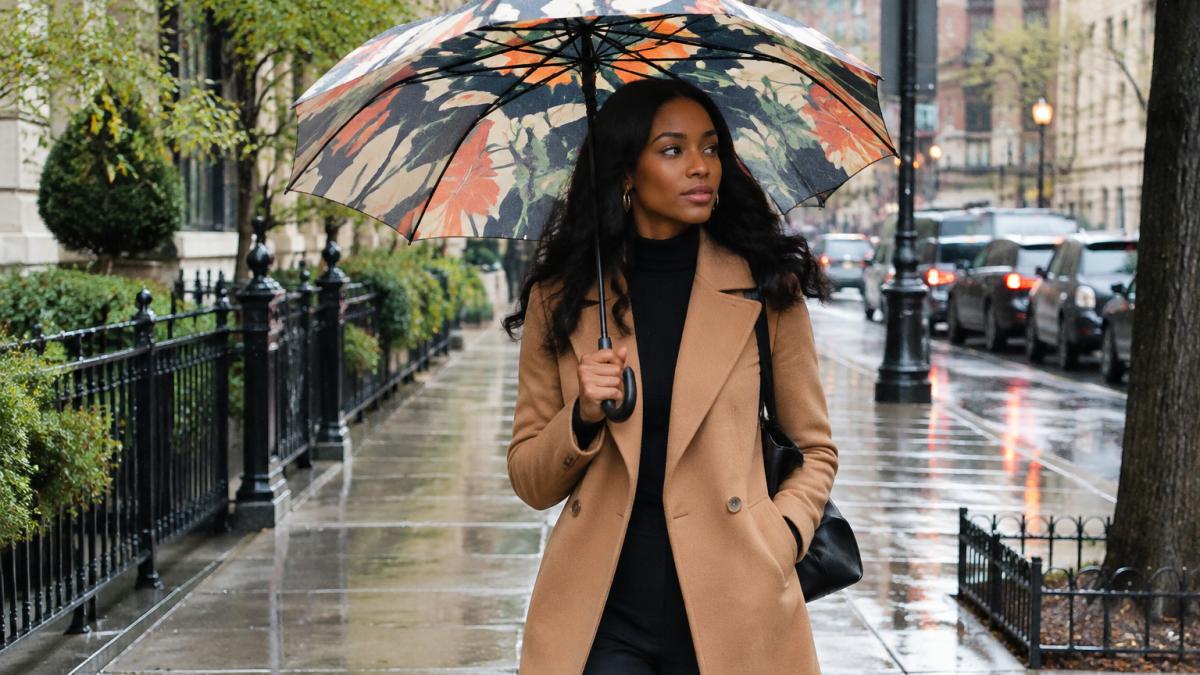
Color strategy. With a neutral wardrobe (navy, gray, black, camel, cream), a printed or brightly colored umbrella works as the focal point and makes an otherwise plain coat look intentional. With a already-patterned or colorful outfit, choose a solid umbrella in a color pulled from the outfit, or a restrained tone-on-tone print, so the two don't compete. A common pattern is to treat the umbrella like a scarf: one statement piece, everything else supporting.
Silhouette and proportion. Stick umbrellas read as more formal and pair naturally with tailored coats, trench coats, and workwear. Compact umbrellas read as casual and suit puffer jackets, rain shells, and weekend wear. A long stick umbrella also changes your silhouette when carried closed, so consider whether you want it to look like an accessory or disappear into your bag.
Handle and hardware. Wood and leather handles warm up an outfit and suit classic coats; rubberized or matte handles look more technical and suit athleisure and rain gear. Metal-tone ferrules and tips are small details, but they're visible when the umbrella is closed and carried at your side.
Routine scenarios. For a work commute, a calm pattern in a classic color (navy, charcoal, burgundy, forest green) reads appropriate in most offices. For school runs and errands, a brighter print is practical as well as expressive, since a distinctive canopy is easier to spot in a crowded pickup line or a rack of identical black umbrellas. For weekends and social outings, a bold artistic print works with simple denim or a neutral coat. Keeping one understated umbrella at the office and one expressive one at home covers both modes without overbuying.
Style-to-function trade-offs. Canopy shape affects coverage: a dome canopy sheds rain well but offers less shoulder protection than a flatter, wider canopy. Dark canopies hide wear and water spots; light canopies show dirt faster but improve visibility on gray days and at crossings. Handle design affects grip comfort on long walks, and a slim handle may look elegant but tire your hand in wind. The Floral Passion Umbrella ($24.95) features vibrant floral artwork and a wide canopy, while the Wrapped In Elegance Umbrella ($24.95) features sophisticated artwork that pairs beautifully with any outfit or occasion.

Watch out: a large, busy print on a compact umbrella can look cluttered when rolled and carried, so check how the pattern reads in its packed form before committing.
The table below sums up how each part of an outfit and routine should shape your umbrella choice.
| Factor | Guidance | Why it matters |
|---|---|---|
| Neutral wardrobe | Use a printed or bright umbrella as the focal point | Makes a plain coat look intentional |
| Patterned outfit | Choose a solid or tone-on-tone umbrella | Stops the two from competing |
| Tailored coats | Pick a stick umbrella | Reads as more formal |
| Puffer or rain shell | Pick a compact umbrella | Reads as casual |
| Wood or leather handle | Pair with classic coats | Warms up the outfit |
| Rubber or matte handle | Pair with athleisure or rain gear | Looks more technical |
| Dome canopy | Good rain shedding | Less shoulder protection |
| Flatter, wider canopy | Better shoulder coverage | Slightly less rain shedding |
Choosing Your Everyday Umbrella from the Creations Of Color Collection
Start with the criteria in this guide: wind resistance, canopy coverage, portability and style. Then match them to how you actually use an umbrella. A commuter in a city may want a compact, wind-resistant frame. Someone who walks a lot in steady rain may want a large canopy. Someone who wants a gift may prefer a design with personal meaning.
Our collection covers all of these needs. The umbrellas featured in this guide are priced at $24.95. Browse the full collection and choose the one that fits your routine, your wardrobe and the weather you face most often.
Frequently Asked Questions
What should I look for in an umbrella for everyday use?
Look at canopy width, frame strength, handle comfort and weight. A wide canopy provides generous coverage, a wind-resistant frame offers durability, and an ergonomic handle gives you a comfortable grip. Lightweight, packable designs fit easily into a bag.
What is the best umbrella for wind and rain?
The best umbrella for wind and rain combines a durable, wind-resistant frame with a generous canopy. The Impact Umbrella and Floral Passion Umbrella from Creations Of Color both feature wide canopies and durable, wind-resistant frames, and each is priced at $24.95. Choose one with a comfortable grip so you can hold it steady when gusts pick up.
Is a stick umbrella better than a folding umbrella?
A stick umbrella usually offers a larger, more stable canopy and a stronger frame, which helps in wind and heavy rain. A folding umbrella is easier to carry and fits into bags more readily. If you walk long distances in bad weather, a stick style is often the better choice; if you need something to tuck away daily, a compact folding model suits you better.
What size umbrella is best for everyday use?
For daily use, a mid-sized canopy that covers you without being hard to manage works best. Very large canopies are better for sharing, while compact models suit bags and short trips. Consider how you will carry it: a canopy that fits your routine and a handle you can hold comfortably matter more than chasing the biggest coverage available.
